


Hi readers, 👋
Welcome to this little March wrap-up.
Disclaimer: This report is for informational purposes only and does not constitute financial advice or investment recommendations. With these reports, I share information based on my research. Always conduct your own research or consult a financial advisor before making investment decisions. I am not liable for any losses arising from the use of this information.
1. Europe must pick its poison
In my last article, I outlined that Europe is on a dangerous path of Angst, and as a result is once again missing the boat on the next major technological milestone.

The article was apparently quite well received (at least judging by the click numbers), which makes me happy, and I’d like to personally thank everyone who chose to subscribe or even opted for a paid subscription to support my writing.
What I didn’t shed sufficient light on: Europe isn’t just paying for access to the technology. It’s also paying for the social consequences.
Twice.
Beyond the infrastructure and marketing spending that flows directly to big US tech like Meta META 0.00%↑, Google GOOGL 0.00%↑, Microsoft MSFT 0.00%↑, and Amazon AMZN 0.00%↑, there are now AI “fees” that European companies pay for efficiency gains to those more or less same corporations.
Any European company that wants to keep pace in the AI era has no real choice. There is no meaningful alternative in Europe.
That sounds like a normal market.
And it is.
But when it comes to the potential AI disruption, I see particularly far-reaching and damaging consequences for Europe.
AI and the Industrial Revolution
If you believe the AI bulls, AI could disrupt markets more profoundly than the internet and perhaps even rival the upheavals of the Industrial Revolution in the 18th and 19th centuries.
Just as a reminder: the Industrial Revolution had far-reaching social and societal consequences. Child labor in textile factories. Sixteen-hour shifts. You name it.
Within just a few decades, it mutated cities from a main street, a church, a town hall and a few houses with some farms in the background into smoke-belching industrial centers, without sewage systems, without housing, without any plan whatsoever for the people who were supposed to toil there.

The 19th century was defined by massive social upheaval and the corresponding counter-movements it sparked, such as the Chartism in England, the silk weavers’ uprisings in France, and pauperism in the German states.
And it took more than a century for Europe to get the social costs of that transformation even halfway under control. And across Europe, the remedies were similar: trade unions, labor law, social insurance, progressive taxation
But there are some differences between the AI revolution and the Industrial Revolution, all of them rather to Europe’s disadvantage.
For one, the AI transformation is playing out in years, not decades. ChatGPT appeared in 2023.
Even though it remains relatively unclear where AI will take us, today, barely three years later, these systems are already contributing measurable shares to knowledge work in fields like law, accounting, software development, and customer service.
If there are professions that will disappear in the short to medium term, there will not be two generations of time to reinvent themselves.

And while Europe back then fought out the conflicts between entrepreneurs and workers, capital and labor, at least on home soil, within a nation-state framework that allowed for taxation and regulation, Europe’s “adversary” this time is external and largely untouchable.
The European Commission, acting as the EU watchdog, cannot summon an OpenAI board member before parliament. Europe cannot levy corporate tax on profits booked in Delaware or the Cayman Islands. Even profit taxes are difficult to implement, because companies can steer where profits are recorded fairly well through intra-group accounting.
Yes, the EU is a large market and important to the American (and Chinese) economy, but so far that fact has not given Europe any real leverage to effectively enforce its fiscal interests.
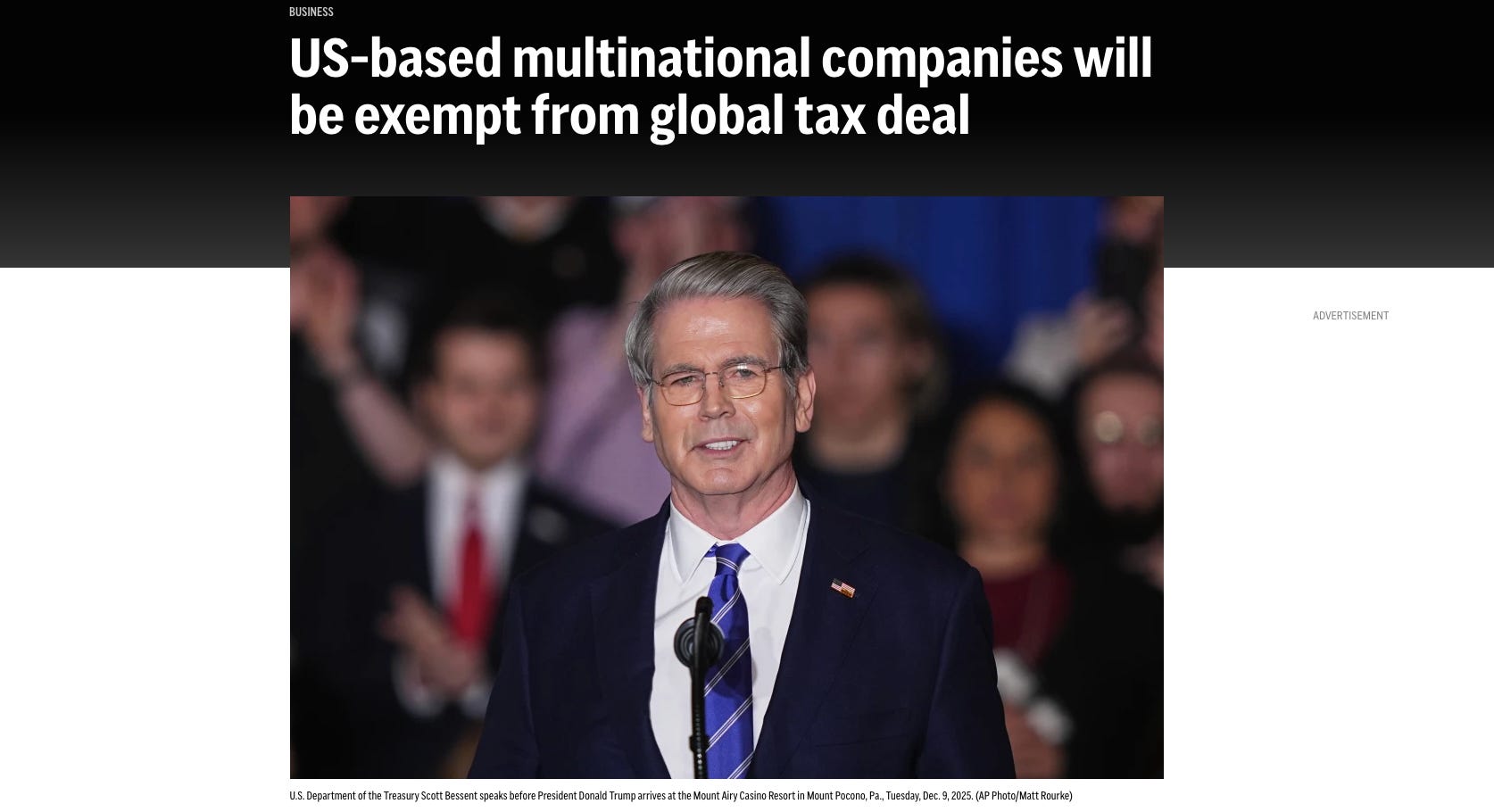
In 2021, for example, more than 130 countries agreed on a global minimum tax of 15% for large corporations with revenues above 750 million euros. 22 of the 27 EU member states have since implemented the rules. One of Trump’s first acts in his second term, however, was an executive order declaring the minimum tax void for the United States. At the same time, the US Congress threatened massive countermeasures against countries that would apply a minimum tax to American corporations.
But back to the Industrial Revolution.
The Industrial Revolution undeniably made Europe richer, despite the social upheaval it brought with it.
The gains generated by the new scale of power and output flowed into local businesses, into wages, into public pockets. The state was ultimately able to redistribute.
However, with AI, the AI value creation is happening geographically elsewhere. Europe is taking on the role of the consumer, paying for efficiency gains with an outflow of capital (and data). As a consequence, the direct and major profits arise where Europe’s tax laws do not reach.
There is reason to fear that this is not a temporary gap.
Rather, it will cement the structural asymmetry that began with the emergence of cloud infrastructure and is reaching its peak with an AI revolution whose ultimate end is not yet in sight.
The winners within Europe are the companies that use US technology to optimize their margins and reward their shareholders with rising profits.
The losers are those workers whose activities are replaced by these algorithms.
A lot is at stake for Europe
Social solidarity through health care systems and social securities, as well as democracy per se, are not given.
Historically speaking, they are inventions of the last 100 to 150 years, and they require stability and prosperity.
It is worth pausing briefly to understand why that is.
Social security systems, trade union rights, universal education, all of it emerged not from moral insight alone, but because industrialization and economic growth created the material foundation that made redistribution possible in the first place.
Bismarck did not invent social insurance in the German Empire out of love for humanity, but because a stable industrial proletariat was economically more productive than a revolutionary one. The welfare state is, to put it simply, a compromise between capital and labor, and is kept alive by taxation. If capital as a tax base disappears, the compromise between capital and labor collapses, and Europe is left without capital or labor, yet with many hungry people accustomed to prosperity.
The irony is almost unbearable: it is precisely the politically left, supposedly woke progressive camp, which most loudly commits itself to protecting these achievements, that is pursuing the regulatory policies most effectively torpedoing Europe’s (technological) independence.
Europe’s current path is not working
A top-down political approach will not solve Europe’s innovation problems. It will make it worse.
Europe’s moral stance of wanting to secure everything in advance and make it ethically sound leads in practice to a paralysis that creates exactly the instability one seeks to prevent.
Regulations like the AI Act operate with risk categories and compliance requirements that are manageable for large, established providers. The major non-European companies have legal departments, lobbying offices, and certification processes.
For a European AI startup with 50 to 100 employees, those same requirements mean that critical resources have to be diverted away from actually building the product.
The structural weakness of this approach lies not only in its speed but in its logic: states are good at scaling known problems. They are bad at betting on possibilities that are still unknown. By the time the first draft of the EU AI Act was finalized, it had already been overtaken by the emergence of LLMs, which were not even within its regulatory scope.
When German politicians launch an initiative celebrated by the media, pledging to double data center capacity by 2030, that is simply laughable against the backdrop of data center growth in the United States, and the approach itself comes dangerously close to central planning.
Europe must pick its poison
Europe faces a choice between two kinds of bad.
Europe can stick to its current path because solidarity, stability and moral values are considered untouchable, and in doing so risks tearing out the very foundation of those achievements. Or Europe lets go of the ambition to know everything, plan everything and enforce everything from above.
Both scenarios cause discomfort. But only the second gives Europe a chance to survive independently and sovereignly.
The most important point here is that this is not about a new plan.
In fact, it is about the opposite of a plan.
It is about opening up spaces that are currently closed off by regulation, fear of liability and bureaucratic review cycles. That is uncomfortable for political systems whose legitimacy rests on steering things and promising outcomes.
But let us look at what the alternative has produced so far: an AI Act that was overtaken by technological reality before it even came into force. Funding programs that finance companies which would not be viable without subsidies. Data center initiatives that are laughable in their ambition measured against what Amazon alone invests in new infrastructure in a single quarter. And a debate about AI safety and ethics that is largely conducted by people who do not themselves use the technology they are talking about, let alone build it.
I can only repeat my criticism of a system that structurally rewards caution and structurally punishes risk. That applies to politics, to public administration, to corporate culture.
Europe was doing so well for so many years, following two devastating wars on European soil, that many people are no longer willing to recognize risk as a productive force. Europe now perceives risk only as a danger to be hedged against.
But Europe will not be able to hedge against the current transformation from the outside. I am convinced that the only way to survive this shift economically is to help shape it from within, through the creative force of European companies and individuals.
My approach to uncertainty
Readers who have been following my blog for a while know the relevance of critical rationalism and antifragility in my thinking and actions.
They are the practical framework with which I navigate uncertainty, and they stand in direct contradiction to what Europe is currently doing politically and culturally.
Karl Popper’s critical rationalism inverts the logic of political action: it is not the best plan that wins, but the one that most quickly recognizes what is wrong.
What is wrong must be acknowledged as a falsification and brought to an end. It is the chainsaw that Argentine President Milei famously took to the Argentine economy.
Europe is going the opposite way.
Europe optimises for certainty. It tries to eliminate risks in advance, regulate technologies in advance, secure outcomes in advance. That is the opposite of critical rationalism.
An AI Act that was overtaken by LLMs before it came into force is the inevitable result of a system that defends theses instead of testing them and discarding them when falsified.
Nassim Taleb’s antifragility goes one step further. Antifragility describes systems that do not merely withstand stress but grow stronger under it. The opposite, fragility, is not weakness but the inability to learn from disruptions.
Sadly, Europe’s systems are structurally fragile: they are optimized for stability, not adaptability. And that is precisely why every new disruption produces not adaptation but resistance. More regulation. More control. More planning.
The paradox: genuine antifragility does not arise from protection against disruptions, but from deliberate exposure to them in manageable doses, combined with the capacity to respond. A startup that fails and learns from it is antifragile. A funding program that structurally prevents failure generates fragility at taxpayers’ expense.
And then there is serendipity. The idea that significant discoveries and breakthroughs are rarely the result of linear planning, but of open, curious engagement with the unexpected. Penicillin was not planned. The internet did not emerge from a Brussels white paper or a parliamentary inquiry. Transformative technologies arise in spaces where chance, openness, and radical freedom of thought converge.
Europe is closing precisely these spaces. Through regulation, through liability law, through the cultural punishment of failure.
Data Act, AI Act, Cyber Resilience Act, NIS2 Directive, Pay Gap Directive, Green Deal, and so on and so on.
How I make my investment decisions
This analysis of Europe’s current state of play naturally influences my concrete investment decisions.
The first and most important principle I follow can be summed up in one sentence:
Never bet against the USA.
The US has the deepest capital markets in the world, the greatest concentration of technological human capital, a risk culture that does not punish failure but treats it as a learning process, and the geopolitical power to rewrite international rulebooks in its favor when necessary.
That is reflected in my portfolio. 54% of my holdings are invested in US equities, with an additional 1.9% in Canadian stocks. Together, around 56% is in North America. 35% is in Europe, 7% in Asia.
I deeply believe that the value creation of the next decade will arise disproportionately in the United States. And naturally, my capital needs to be working there.
The second principle is the harder one, because it requires permanent self-discipline:
Ignore the noise.
Twitter is full of it. Substack, unfortunately, is increasingly so as well. Authors shouting about their 30%, 40%, sometimes 60% annual returns as if that were proof of superiority.
I have little time for this financial pornography, not because I consider the numbers untrue (I simply consider them irrelevant), but because they set the wrong incentives.
Anyone who wants to build generational wealth, meaning wealth that extends beyond one’s own life planning, does not think in quarterly results or annual returns. They think in decades. Short-term outperformance is in many cases simply risk that has not yet materialized. The market will correct that at some point, and whoever is not set up in an antifragile way will pay a bitter price.
The third principle follows from this.
No all-in bets, even when conviction is high.
I believe that SaaS stocks are currently structurally undervalued. The market is pricing in a disruption by AI that will not materialize in that form and at that speed, at least not for the category of vertical, specialized B2B SaaS providers. Salesforce, Intuit, HubSpot, ServiceNow, you name it.
But even this conviction is a thesis that can be falsified. That is why I do not put everything on one card. Concentration creates great leverage, but also fragility. Broad positioning with selective overweighting, and therefore risk exposure, generates antifragility.
My target return is around 10% per year, with the ambition to push it a few percentage points higher through selective decisions. Whether I will manage that, I do not know. Nobody knows.
How I do it, which positions I buy, which I sell, what guides me in the process, I document monthly for my paid subscribers in my transparent portfolio updates. Not as a recommendation. But as an honest insight into my journey, which is far from over, and which might give readers interesting guidance and an example of how to take care of one’s financial future over the long term in the stock market.
2. Is Nvidia cheaper than the market?
Quite a change in topic now (not sure if makes more sense to publish more frequently but then topic-focussed).
According to sources citing Goldman Sachs, Nvidia’s NVDA 0.00%↑ forward price-to-earnings (forward PE) ratio has tumbled to match the broader S&P 500 for the first time in more than 10 years.
Let’s look at the numbers:
S&P 500’s forward PE ratio currently sits at 20.45.
Nvidia’s forward PE ratio is 19.91.
This is noteworthy because the Nvidia stock is only down 17% off its all-time high, so the value compression has nothing to do with stock price losses. The parity with the S&P 500’s valuation is nothing but a sign that Nvidia has grown into its valuation, putting the 68.5% p.a. stock price performance since March 2016 on an impressive footing.
Revenue in Q4 2026 grew by 73.2%, after 62.5% in Q3 2026 and 55.6% in Q2 2026. EPS rose YoY from $0.89 to $1.76 (Q3 2026: $1.30; Q2 2026: $1.08; Q1 2026: $0.76).
Crazy, and an honest disclaimer that I was also on the “this stock is too expensive” team for quite some time, as I underestimated the pace of Nvidia’s growth acceleration.
So here we are now, with Nvidia and the broader S&P 500 being on par based on their forward PE multiples. Considering Nvidia’s expected growth in EPS and revenue into account, which is quite above the S&P 500’s growth, Nvidia’s valuation doesn’t make much sense. But who am I to predict the stock’s future :).
3. Now (as always) is a good time to buy
I find it rather tedious to write comments and words of encouragement every time the stock markets get a bit volatile. Right now, the stock markets are falling. So be it.
I just want to point out that sentiment is very poor again at the moment. You can see that in the Fear & Greed Index, but also in the volatility.
The CBOE Volatility Index is spiking. By the way, guess who buys CBOE shares every month? :)
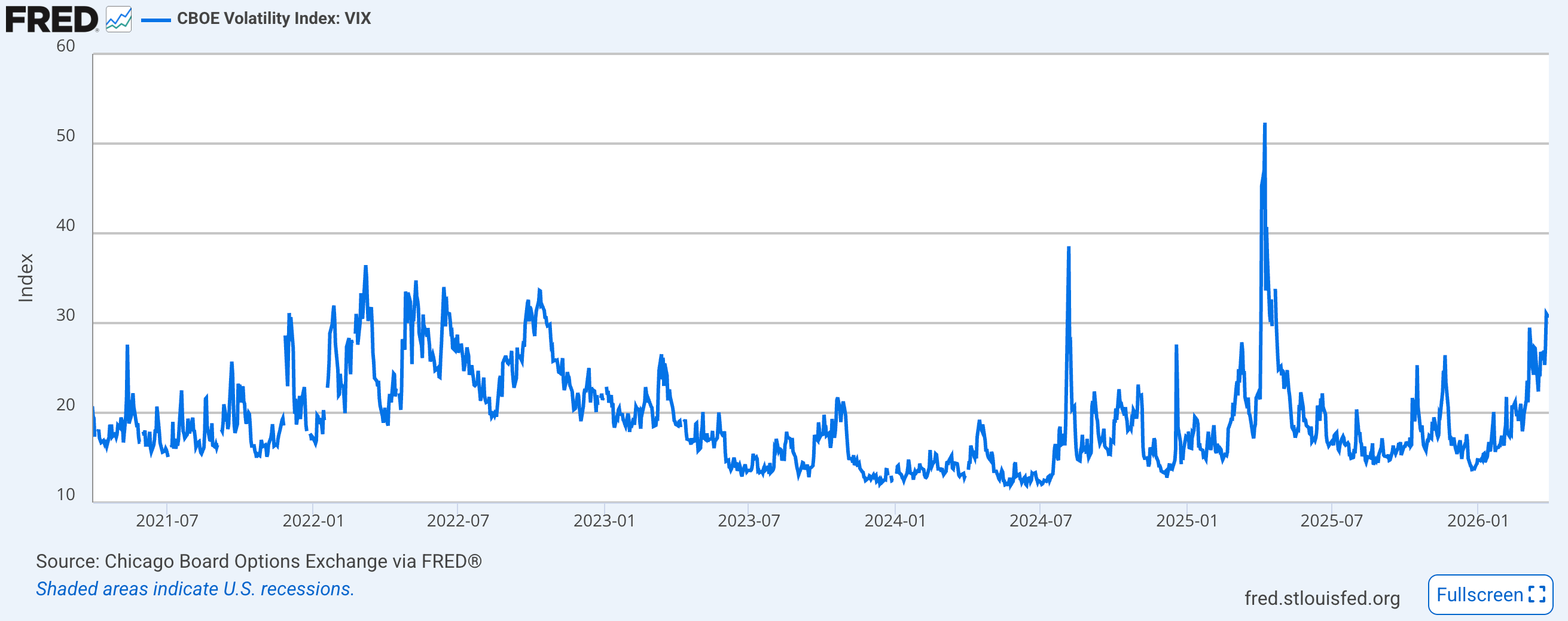
Historically speaking, though such phases always present good buying opportunities and are the worst possible times to sell shares in companies.
4. My monthly income with dividends in March:
My investment approach is simple and consists of three pillars:
Active income.
Passive income.
Conversion.
Dividends fall into the last two categories. They are passive because they provide a cash flow without the need to go to work. Additionally, they are an essential pillar for conversion since they can be reinvested to generate even more income in the future.
That is the theory. Now, let’s get down to practice.
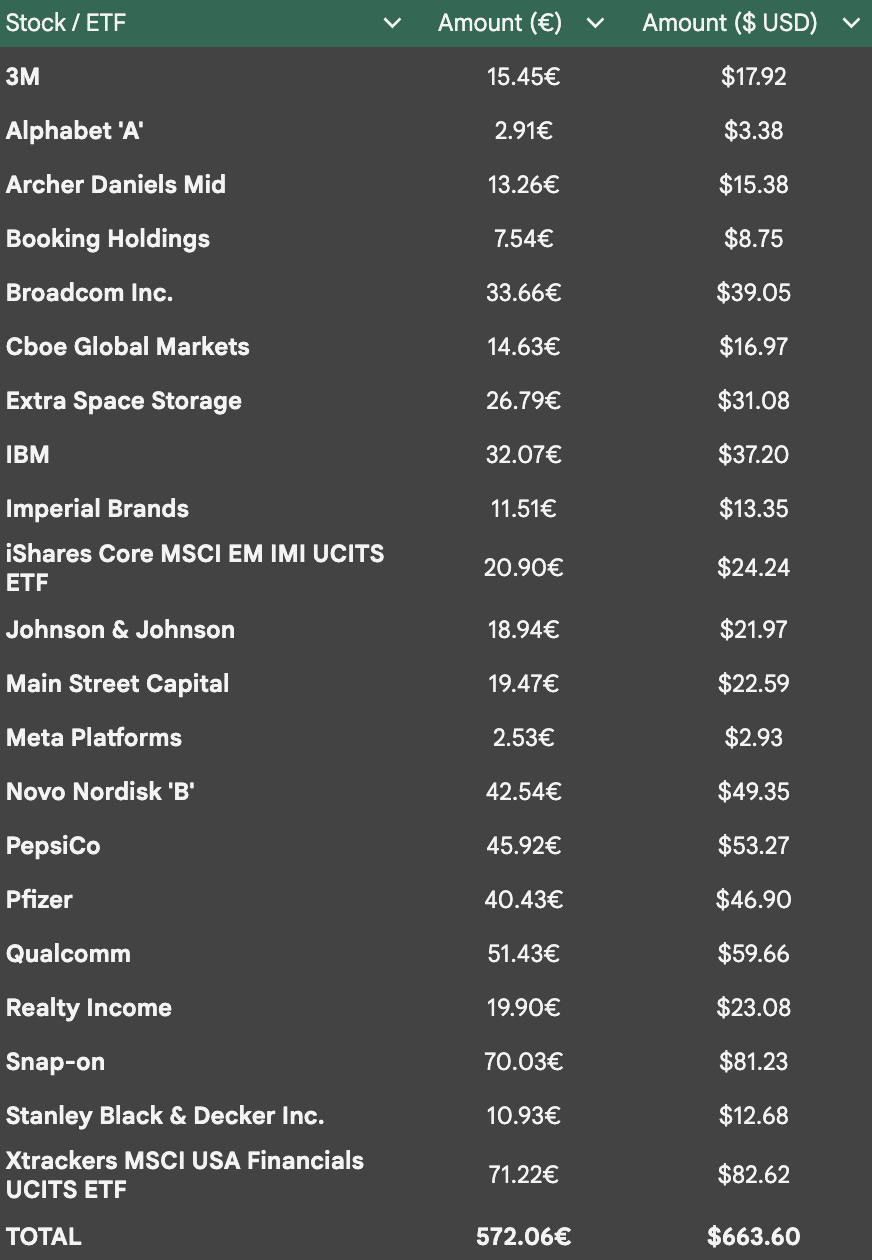
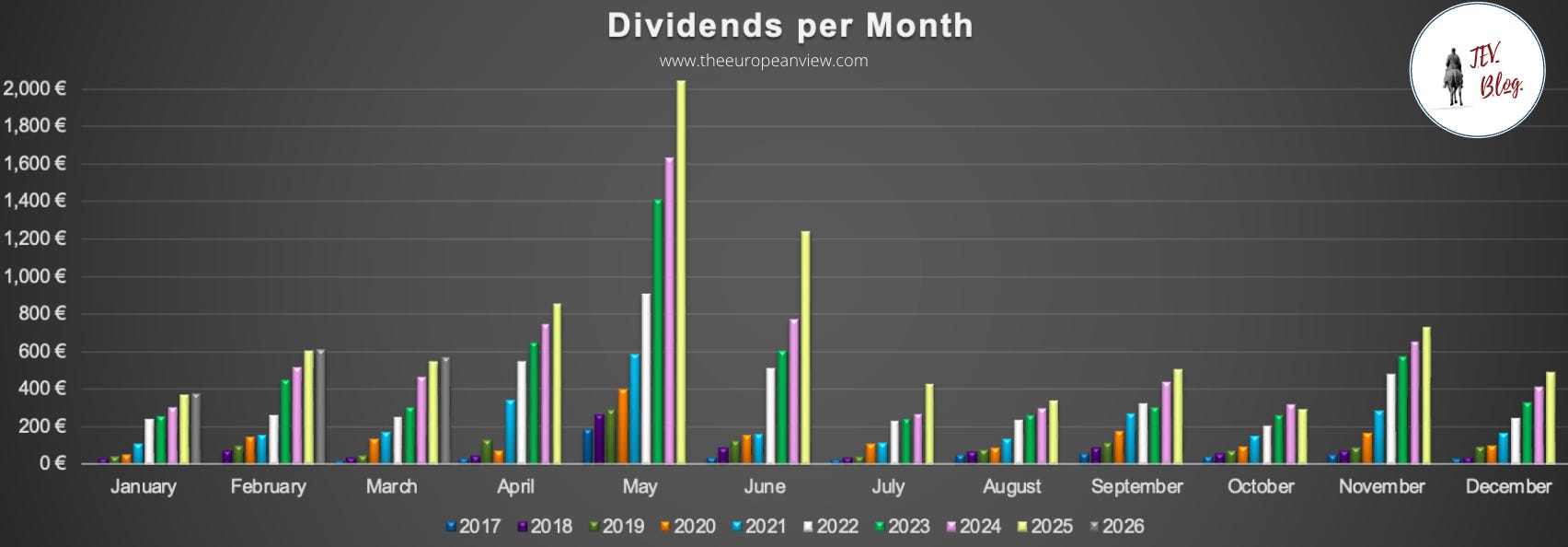
This month, my cash-flow approach generated the following income through dividends:
So overall:
the total monthly dividend income in March (after taxes) was: €572.06 / appr. $663;
compared to last year, the dividend growth was okay ( 3.4% YoY);
⌀ monthly dividend income (ttm): €709 / appr. $822;
⌀ monthly dividend income (ttm) compared to the previous month: +0.2%.
Here is the big picture:
Transactions in March
The following part is for paid subscribers only. It includes an overview of the stocks I purchased in March and additional portfolio details.
Since this report contains valuable/personal insights, I want to restrict access to paying subscribers only. I invest a lot of time and effort into writing these pieces/researching companies, etc.
So if my work is worth the price of a coffee to you, it would go a long way in keeping me motivated and providing even more insights! ☕️
Since I’m just starting, I’ve set the lowest fee and am offering a discount for the first 10 paid subscribers. So now is the perfect time to join! 💡✨
Be one of the first supporters and grab the discount by clicking this link:
👉 https://theeuropeanview.substack.com/86a7d5f8 👈
